Show Me the Problem: How Studios Are Replacing the Written Brief With Live Experience
For decades, the written brief was treated as sacred. It arrived in the inbox—sometimes polished, sometimes chaotic—and the studio's first task was to decode it. Translating a client's language into a creative framework was considered part of the craft. Assumptions were made, questions were asked in a follow-up call, and the work began.
But assumptions, however educated, carry a cost. And a growing cohort of premium creative studios across the United States is deciding that cost is no longer acceptable.
The shift is subtle but consequential: rather than asking clients to write about their challenge, these studios are asking clients to live it in the room.
The Limits of Language
A written brief is, at its core, a translation. The client experiences a problem—in their market, in their organization, in their customer relationships—and then converts that lived experience into language. That language is then handed to a studio, which must reverse-engineer the original experience from the words alone.
Every step in that chain introduces loss. A VP of Marketing describing a product's "premium positioning" may mean something entirely different from what a Creative Director imagines when reading the same phrase. A founder characterizing their brand as "approachable but authoritative" may be drawing on emotional cues that no adjective can fully capture.
The written brief asks clients to be precise about things that are, by nature, imprecise. And it asks studios to be confident about things they have not yet witnessed.
The Experiential Brief in Practice
What does an experiential brief actually look like? The format varies by studio and by client, but the underlying principle is consistent: the client is invited to demonstrate rather than declare.
In practice, this might mean a product company bringing their physical goods into the studio's space and walking the creative team through a purchase decision as a customer would experience it. It might mean a service-based client role-playing a client intake call while the studio observes. It might mean a retail brand guiding the team through their actual website, narrating the confusion points in real time rather than summarizing them in a slide deck.
For studios with multimedia production capabilities, the experiential brief can extend further—clients may share raw footage of customer interactions, unedited testimonials, or even walk the team through their physical environment via video call. The goal is not performance. The goal is proximity to the actual problem.
What Goes Unwritten
The most significant benefit of this approach is not the information it surfaces—it is the information it reveals without being asked.
When a client walks a studio through their product in real time, the hesitations speak. The moment a founder stumbles over how to explain a particular feature, or the moment a marketing lead glances at a colleague before answering a question about pricing, registers in ways that no brief would ever document. Studios that witness these moments gain access to a layer of organizational reality that written communication systematically filters out.
Hidden constraints become visible. A client who writes confidently about a "flexible timeline" may reveal, in conversation, that a board presentation in six weeks is actually driving everything. A brand that describes itself as open to bold creative directions may demonstrate, through its existing materials, a deep institutional conservatism that would have derailed the first round of concepts.
None of this is deception on the client's part. It is simply the gap between how organizations understand themselves and how they actually operate—a gap that language tends to close prematurely.
Reframing the Studio's First Role
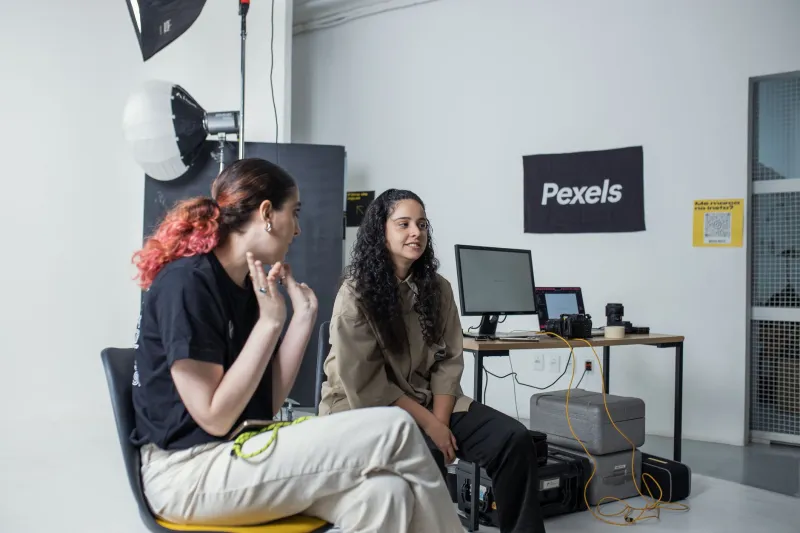
Adopting the experiential brief requires studios to reframe their role in the opening phase of a project. The studio is no longer a recipient of information; it is an active investigator. Creative directors, photographers, and strategists must develop a different set of skills—closer to ethnographic research than to briefing analysis.
This shift has implications for how studios staff discovery sessions. A senior creative presence in the room is no longer optional. The person who will ultimately shape the work needs to be the one observing the client's hesitations, watching where enthusiasm is genuine and where it is rehearsed. Delegating discovery to a junior account manager and then briefing the creative team secondhand recreates the very problem the experiential approach is designed to solve.
For studios that have built their reputations on the quality of their creative output, this investment in the front end of a project is not a cost—it is a form of quality control.
The Client Benefit That Often Goes Unspoken
There is a dimension of the experiential brief that benefits clients in ways they rarely anticipate: it forces organizational clarity before creative work begins.
Preparing for an experiential brief session—gathering the actual product, curating the honest customer journey, selecting the materials that represent the real brand rather than the aspirational one—requires internal alignment. Teams that have not spoken candidly about their challenges must do so before they can demonstrate them. Gaps in consensus that would have emerged painfully mid-project surface instead in a structured, productive setting.
In this sense, the experiential brief functions as a diagnostic tool. Studios that facilitate this process skillfully often find that clients leave the session with a clearer understanding of their own challenge than they arrived with—and that the creative work produced in response is more precisely targeted as a result.
Designing for the Actual Problem
The ultimate argument for the experiential brief is straightforward: creative work that solves the imagined problem is not creative work that succeeds in the market.
A campaign built on a misread brief may be visually accomplished. It may earn internal praise and pass through approval without friction. But if it was designed to address a challenge that was translated imperfectly—if it answers the written version of the problem rather than the lived version—it will underperform in ways that are difficult to diagnose after the fact.
Studios that commit to the experiential approach are, in effect, insisting on accuracy before artistry. They are recognizing that the most sophisticated visual thinking in the world cannot compensate for a misunderstood problem.
The brief, ultimately, is not a document. It is an act of understanding. And understanding, as every serious creative practitioner knows, begins with observation—not with reading.